

Multi Application Board
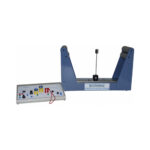
The Multi Applications Board (MAB) contains a variety of experiments on one board and is ideal for learning how to interface a PC or Microcontroller to applications. The techniques of controlling data transmission, keyboard entry, digital sound production, D.C. motors, heaters, and visual displays can be controlled using a PC with a programming language, the MAB can also be used as target for a microcontroller. This involve the fundamentals of microprocessor or computer programming, such as decision making, D to A and A to D conversion, open and closed loop control, creating delay loops, using subroutines and event counting.
The Multi Applications Board (MAB) contains a variety of experiments on one board and is ideal for learning how to interface a PC or Microcontroller to applications. The techniques of controlling data transmission, keyboard entry, digital sound production, D.C. motors, heaters, and visual displays can be controlled using a PC with a programming language, the MAB can also be used as target for a microcontroller. This involve the fundamentals of microprocessor or computer programming, such as decision making, D to A and A to D conversion, open and closed loop control, creating delay loops, using subroutines and event counting.
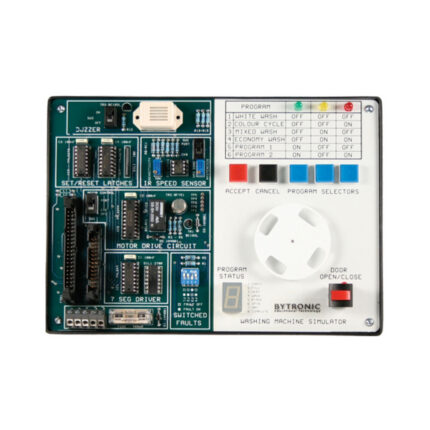
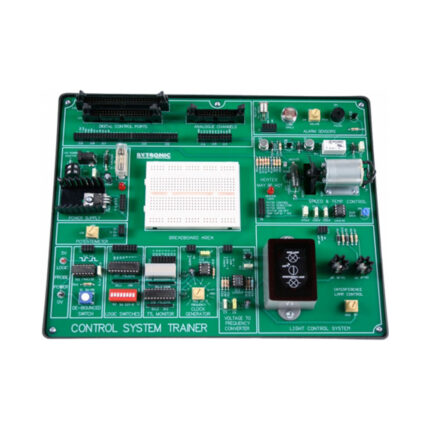
The MAB Primary components are: a 12V d.c. motor, this is used for closed-loop control to drive a fan which cools a heater/resistor to a set temperature. Several other elements are on the MAB these include a Piezo buzzer, TTL monitor, a bank of logic switches, a logic probe power point, a strain gauge and amplifier, a bar-graph and a seven segment display, switched faults and a potentiometer that can be used as an analogue input.
Experiments:
- Switched inputs
- Control of an output port
- Use of the Analogue to Digital Converter
- Use of the temperature sensor
- Digital to Analogue Converter
- Control of the buzzer frequency
- Driving the seven segment display unit
- Keypad scanning
- Pulse Width Modulation control of the DC motor unit
- Closed loop control of the DC motor unit
Key Features
- Building control circuits and PC control programming
- Introduces electronic control techniques
- Control of a D.C. motor, direction control
- Temperature control
- ADC and DAC converters
- Keypad input
- Audible and visual indictors
- Several other projects with varying complexity
- Control from a PC or Microcontroller
- Switched faults
| Brand | Bytronic |
|---|